
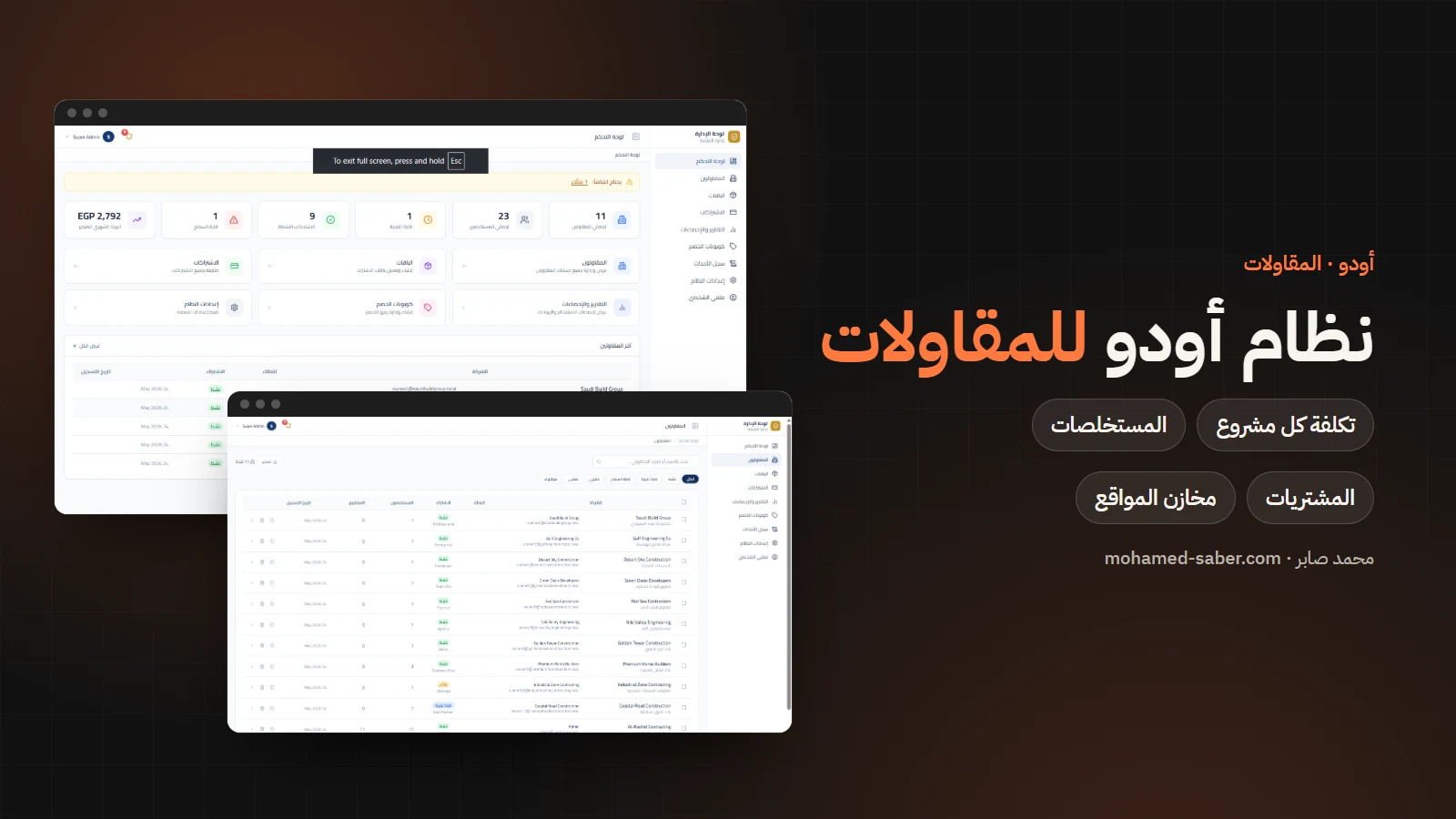
In short: Odoo covers a contracting company's needs through its core apps: Projects, Purchase, Inventory and analytic accounting. There is no app called "construction", but set up properly you see the cost and profit of every project and site and follow progress billing and purchasing in one place.
I have delivered Odoo systems for contracting companies and also built dedicated contractor software such as Moqauel for contracting firms and the Amar app for individual contractors. This article covers what Odoo gives a contractor and what needs customising.
Contractor needs and how Odoo covers them
Need | In Odoo |
|---|---|
Cost and profit per project or site | An analytic account per project, linked to every transaction |
Tracking work and stages | Projects app: tasks, stages and owners |
Progress billing | Milestone invoicing, with the certificate layout customised |
Buying materials per site | RFQs and purchase orders linked to the project |
Main store and site stores | Multiple warehouses and locations with transfers |
Labour and expenses | Time and expenses recorded against the project |
Tax and e-invoicing | By country: Egypt ETA or Saudi ZATCA |
What usually needs customising
- The progress certificate with items, executed quantities, percentages and retentions.
- Subcontractors with their accounts and payments per project.
- Reports management is used to, such as a weekly project status report.
Odoo comes in two editions: Community, free and open source, and Enterprise, a per-user subscription with extra apps and features. Prices vary by country and plan, so check the official pricing page; I recommend the right edition during analysis.
Rolling out Odoo in a contracting company
- Analyse how you work today: projects, sites, the purchasing cycle and the certificate format.
- Set up accounts, taxes, projects and analytic accounts.
- Import master data: customers, suppliers, items and opening balances.
- Customise only what is needed, then test on a real project.
- Train the team and go live, then add stores and labour in stages.
A worked example: from material request to site cost
- The site engineer requests steel or cement against the project from a simple screen.
- Purchasing sends a request for quotation to several suppliers and picks the best.
- The purchase order is issued on the project's analytic account.
- Goods are received in the site store and issued against the work item.
- The supplier bill is posted in accounting and the cost appears in the project report at once.
This cycle ends the "where did the materials go" problem: you know the real spend of each site on any day instead of waiting for month-end closing.
Reports management needs
- Profit per project: certificates versus materials, labour and subcontractors.
- Actual spend versus budget per project and item.
- Approved but uncollected certificates per client.
- Amounts owed to subcontractors and suppliers.
- Material balances at each site and store.
Odoo or a ready-made construction package?
Criterion | Odoo | Ready-made construction package |
|---|---|---|
Accounting, stock and purchasing | Integrated in one system | Often needs a link to separate accounting software |
Flexibility and customisation | High, open code | Limited to what the vendor offers |
Growth and new departments | Extra apps for HR, sales and more | Depends on the vendor |
Getting started | Needs good analysis and setup | Faster, but may not fit how you work |
What drives the cost of an Odoo rollout for contractors?
- The edition and number of users.
- The number of companies, branches and sites.
- The amount of customisation, especially the certificate layout and reports.
- Migrating data from the old system.
- Training and post-launch support.
E-invoicing
In Egypt your invoices must go through the ETA e-invoice system, and in Saudi Arabia they must comply with ZATCA. Read the Egypt e-invoice guide with Odoo and the ZATCA phase 2 guide with Odoo.
Book an analysis session for your company, or see Odoo ERP solutions.