
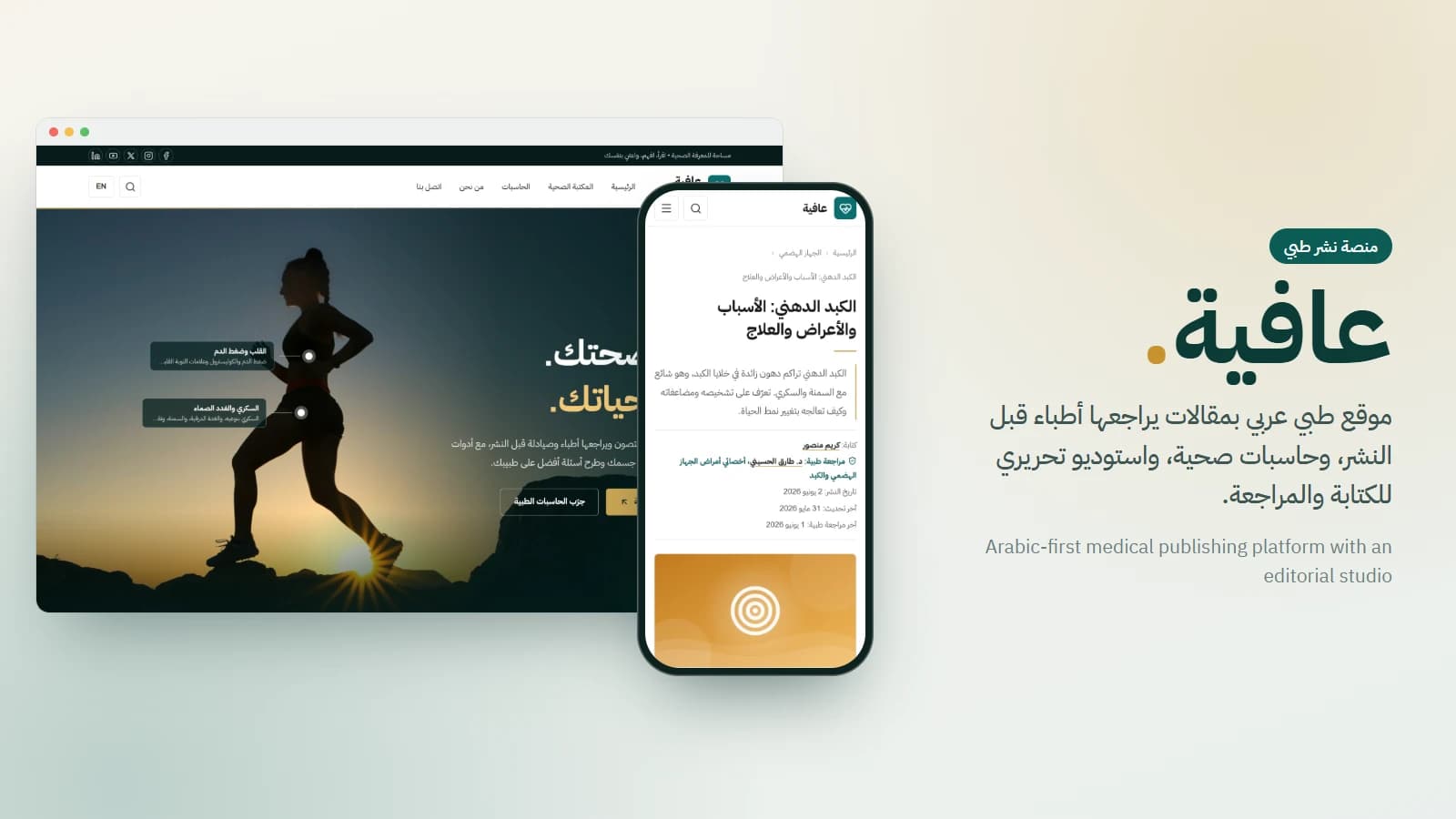
Project Overview
Afia (عافية) is an Arabic-first medical publishing platform built from a client brief: a public website of medically reviewed health articles, a drug directory, interactive health calculators, and an editorial studio where writers draft, independent medical reviewers approve, and administrators publish. It is designed to meet Google's expectations for health content (E-E-A-T, structured data, AdSense policies) from the first line.
Three apps share one GraphQL API: a NestJS backend on PostgreSQL, a Next.js public site (right to left, with optional English), and a React studio in Arabic and English with light and dark themes.
Public Website
- Article template with breadcrumb, author and medical reviewer bylines, published, updated and last-reviewed dates, a quick clinical facts table (specialty, symptoms, diagnosis, ICD-10), key takeaways, comparison tables, numbered references, and a required "when to see a doctor / emergency" box
- FAQ as native details elements, related articles, author and reviewer profile pages, and a medical disclaimer under every article
- Four calculators that run in the browser: BMI, pregnancy due date, calories and water, and ovulation
- Health library, medical categories, live search, About with the medical team, a contact form with honeypot, rate limit and Turnstile, and a real 404 page
- SEO: schema.org structured data, sitemaps, RSS feeds, llms.txt, canonical and hreflang links; AdSense review and live modes behind Google Consent Mode, never on policy pages, search or 404
Editorial Studio and Review Workflow
- Draft → pending medical review → approved → published; any edit of approved or published content sends it back to draft and takes it off the site
- Approval applies to one exact revision, by a verified reviewer who is neither the author nor the last editor; saves use optimistic concurrency, transactions, full revision snapshots and an audit trail
- Quality rules enforced by the API (drug monographs need 14 sections and 600+ words; no placeholder text reaches the site)
- Rich-text editor, people and reviewer profiles, categories, reader messages inbox, site settings, and a launch-readiness report that lists exactly what is still missing
- Staff two-factor authentication (authenticator app and recovery codes), with an option to require it for admins and reviewers at the API level
Engineering and Quality
Self-hosted IBM Plex Sans Arabic, image uploads re-encoded to WebP with metadata removed, CDN purge of the exact affected URLs on publish, edit and unpublish, backups with a restore drill, and Docker, Compose and nginx deployment files. A 17-stage QA script runs unit tests, PostgreSQL integration tests, browser flows for publishing and two-factor sign-in, GraphQL limits and access control, AdSense and launch modes, cache headers, and accessibility (axe) and lab Web Vitals checks.
Status: the engineering side of the brief is implemented and tested. Launch waits on the client's real medical content, reviewer identities, legal text and AdSense account. The screenshots show demo content.