
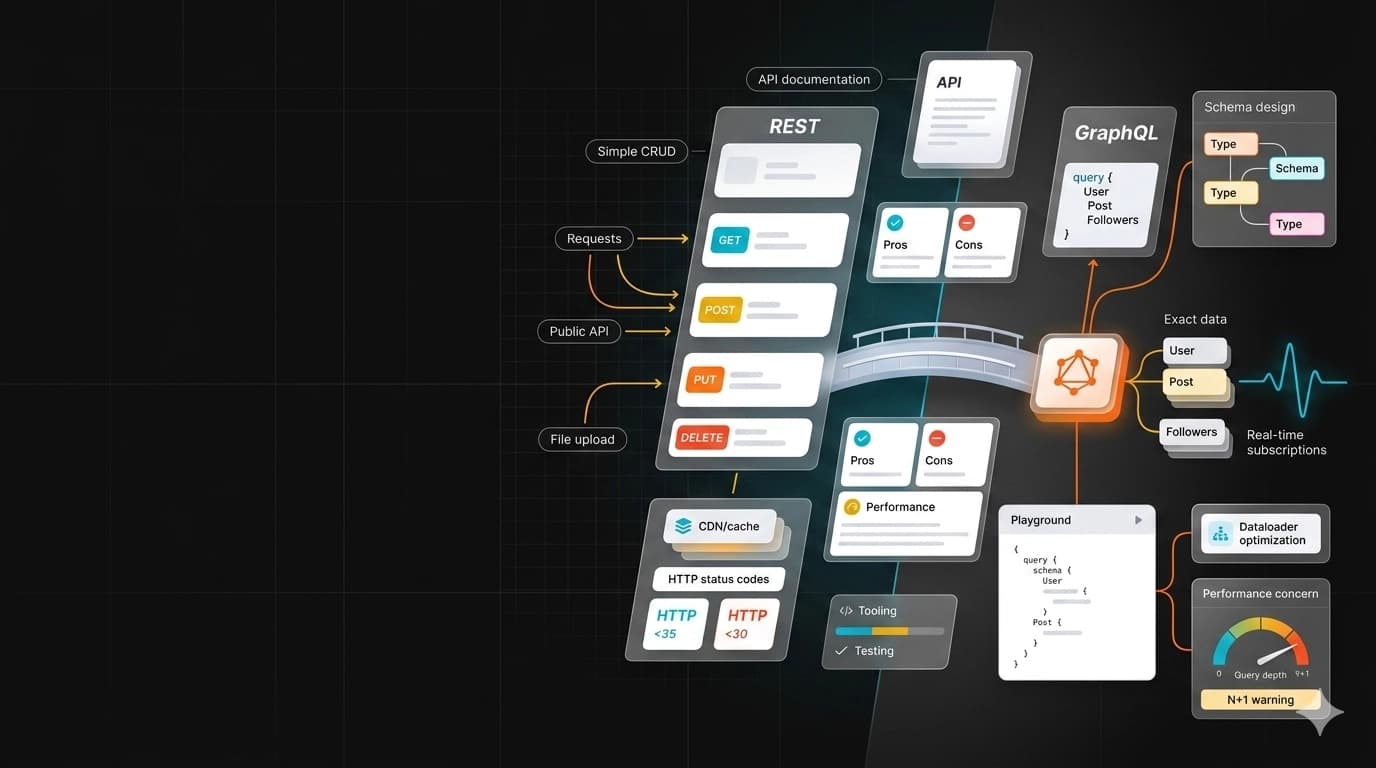
Choosing between GraphQL and REST is a common dilemma for developers building modern APIs. This guide will help you make an informed decision for your next project.
What is REST?
REST (Representational State Transfer) is an architectural style that uses HTTP methods (GET, POST, PUT, DELETE) to perform CRUD operations on resources identified by URLs.
What is GraphQL?
GraphQL is a query language and runtime that allows clients to request exactly the data they need, nothing more and nothing less.
Key Differences
Feature | REST | GraphQL |
|---|---|---|
Data fetching | Multiple endpoints, over-fetching common | Single endpoint, exact data requested |
Versioning | URL versioning (/v1/, /v2/) | No versioning - schema evolves |
Learning curve | Simple, widely known | Steeper, requires schema design |
Real-time | WebSocket or polling | Built-in subscriptions |
Error handling | HTTP status codes | 200 OK with errors object |
File uploads | Native multipart forms | Requires extensions |
Code Comparison
REST API Example
// Multiple requests
GET /api/users/123
GET /api/users/123/posts
GET /api/users/123/followers

// Response (over-fetching)
{
    "id": 123,
    "name": "Mohamed",
    "email": "mohamed@example.com",
    "createdAt": "2024-01-01",
    "lastLogin": "2024-02-01",
    "preferences": {...},
    // 20+ more fields we don't need
}
GraphQL Example
// One request, exact data
query {
    user(id: 123) {
        name
        posts {
            title
            createdAt
        }
        followers {
            name
        }
    }
}

// Response
{
    "data": {
        "user": {
            "name": "Mohamed",
            "posts": [
                { "title": "Post 1", "createdAt": "2024-01-15" },
                { "title": "Post 2", "createdAt": "2024-02-01" }
            ],
            "followers": [
                { "name": "Ahmed" },
                { "name": "Sara" }
            ]
        }
    }
}
When to Choose REST
- Simple APIs with few relationships - Blog posts, product catalogs
- Resource-based operations - CRUD on independent resources
- Public APIs - Easy caching with HTTP semantics
- File upload/download - Native support in HTTP
- Simple caching requirements - CDN and browser caching work well
- Team lacks GraphQL experience - REST is simpler to implement
When to Choose GraphQL
- Complex data graphs with many relationships - Social networks, dashboards
- Multiple clients (web, mobile, desktop) - Each client needs different data
- Rapid frontend iteration - No backend changes for new fields
- Real-time requirements - Built-in subscriptions
- Mobile apps with limited bandwidth - Minimize payload size
- Federation/GraphQL Gateway - Combine multiple services
GraphQL Implementation Example
const { ApolloServer, gql } = require('apollo-server');

// Type definitions
const typeDefs = gql"
        type User {
            id: ID!
            name: String!
            email: String!
            posts: [Post!]!
            followers: [User!]!
        }

        type Post {
            id: ID!
            title: String!
            content: String!
            author: User!
            createdAt: DateTime!
        }

        type Query {
            user(id: ID!): User
            users: [User!]!
            post(id: ID!): Post
            search(query: String!): [SearchResult!]!
        }

        type Mutation {
            createPost(title: String!, content: String!): Post!
            updateUser(id: ID!, name: String): User!
            deletePost(id: ID!): Boolean!
        }

        type Subscription {
            postCreated: Post!
        }
        ";

// Resolvers
const resolvers = {
    Query: {
        user: (_, { id }) => User.findById(id),
        users: () => User.find(),
        post: (_, { id }) => Post.findById(id),
        search: (_, { query }) => SearchService.search(query)
    },
    User: {
        posts: (parent) => Post.find({ authorId: parent.id }),
        followers: (parent) => User.find({ followerIds: parent.id })
    },
    Mutation: {
        createPost: (_, { title, content }, { user }) => {
            if (!user) throw new Error('Not authenticated');
            return Post.create({ title, content, authorId: user.id });
        }
    }
};

const server = new ApolloServer({ typeDefs, resolvers });
server.listen().then(({ url }) => console.log("GraphQL ready at url "));
Performance Considerations
- REST caching: HTTP caching works out of the box
- GraphQL complexity: Deep queries can cause performance issues (use query depth limits, persisted queries)
- Databases: GraphQL resolvers can cause N+1 queries (use dataloader)
- CDN: REST works great with CDN caching; GraphQL requests are usually POST
Hybrid Approach
Many successful companies use both:
- REST for: Public APIs, simple CRUD, file operations
- GraphQL for: Complex UIs, mobile apps, BFF (Backend for Frontend)
Tooling and Ecosystem
- REST tools: Postman, Swagger, OpenAPI, Insomnia
- GraphQL tools: GraphiQL, Apollo Studio, GraphQL Playground, Hasura, Apollo Federation
Conclusion
Both REST and GraphQL have their place. Choose REST for simpler APIs, public endpoints, and when HTTP caching is critical. Choose GraphQL for complex data graphs, multiple client types, and when frontend development speed is a priority. In some cases, using both may be the optimal solution.